How to Switch from Brandwatch to OneUp
Brandwatch is quote-only and starts around $800 a month. OneUp Intermediate is $48. A step-by-step migration guide...
Contents
Brandwatch is an enterprise social intelligence platform. Its Consumer Intelligence product tracks conversations across social media, news, blogs, and forums, and its Social Media Management suite adds a publishing calendar, approval workflows, and a unified inbox. If your team bought Brandwatch for listening and research, it is hard to beat.
But if the part of Brandwatch you actually open every day is the publishing calendar, the maths is uncomfortable. Brandwatch publishes no prices — every contract is a custom quote through sales, with annual contracts as the standard — and third-party data puts even small-team deployments around $800 to $1,500 a month. OneUp Intermediate is $48 a month billed annually for 15 accounts, with post approvals included. The head-to-head is in Brandwatch vs OneUp.
Quick verdict
Switching from Brandwatch to OneUp makes sense if the publishing calendar is your daily work and deep listening is occasional — you keep approvals and an inbox from $48 a month instead of a custom enterprise quote.
- Brandwatch pricing is quote-only, with third-party estimates from around $800 a month for small teams to $5,000-plus for enterprise setups.
- OneUp Intermediate is $48 a month billed annually for 15 accounts, with post approvals included.
- Brandwatch's listening archive, influencer marketing, and paid-ads calendar do not transfer — keep Brandwatch for research, or replace basic monitoring with OneUp's social listening.
Why teams switch
You cannot see the price. Brandwatch has no published rate card. Every number comes from a sales conversation, and contracts typically run 12 to 24 months. That makes budgeting a negotiation rather than a decision, and it means a small team pays enterprise money for a calendar it could run for $48 a month.
You are paying for a suite to use one module. Brandwatch sells three solutions — Consumer Intelligence, Social Media Management, and Influencer Marketing — and the listening side is where its depth lives. If your team rarely opens those tools, the subscription is mostly paying for a scheduler.
The network list is narrower than it looks. Brandwatch's publishing module covers Facebook, Instagram, X, LinkedIn, TikTok, YouTube, and WhatsApp. OneUp publishes to 12 networks, adding Snapchat, Discord, Bluesky, Threads, and Pinterest, plus Google Business Profile.
How to switch, step by step
1. Audit which Brandwatch modules you actually use
List what your team touches weekly: the publishing calendar, approvals, the inbox, listening queries, influencer campaigns, and paid ads. Most teams find the calendar and approvals are the daily work; listening queries run monthly at best.
2. Export your calendar and media
Brandwatch has no one-click export of a full scheduled queue, so copy your upcoming scheduled posts into a spreadsheet — captions, links, dates, and times — and download any media not stored elsewhere.
3. Check your contract renewal date
Note your renewal date and any notice window, and time the switch so OneUp is live before you give notice. The general migration playbook is in Switching Scheduling Tools? How to Migrate Your Content Backlog to OneUp.
4. Start a trial and connect your accounts
Start OneUp's 7-day free trial and connect your accounts. Each account counts once: 5 on Basic, 15 on Intermediate, 30 on Growth, 80 on Business. Connect Snapchat, Discord, Bluesky, and Threads at the same time, so your first OneUp queue is wider than your last Brandwatch one.
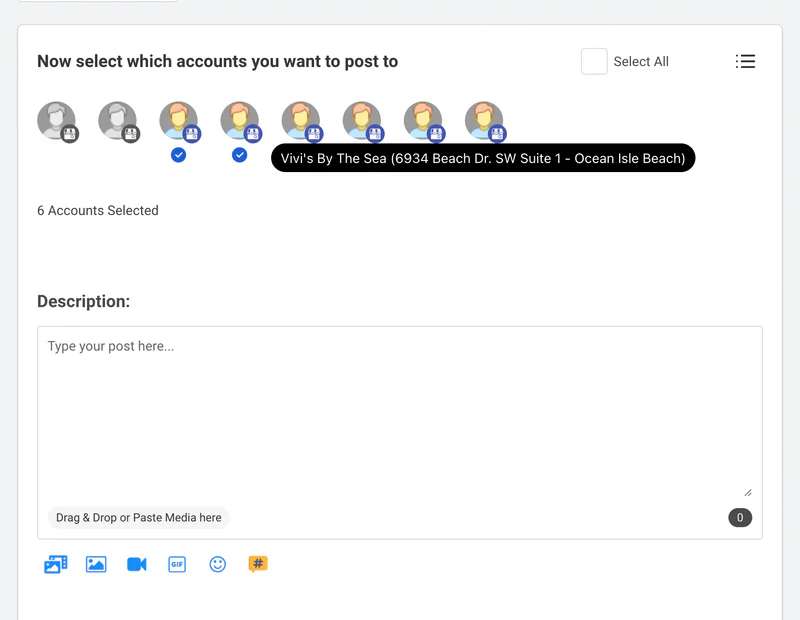
5. Rebuild your queue with bulk upload
Use OneUp's bulk upload to recreate your posts from the spreadsheet — up to 200 at a time. Set your posting timeslots once, and OneUp fills them automatically. Turn any recurring Brandwatch content into recurring posts in OneUp: pick a post, choose how often it repeats, and it re-shares itself.
6. Recreate your approval workflow
Recreate the same chain in OneUp — but note the boundary: approvals start on Intermediate, not Basic, so pick Intermediate or above before inviting approvers. Test with one real post first.
7. Set up crossposting workflows
Create a crossposting workflow — "every new Instagram post also goes to Facebook, X, and Threads" — and OneUp handles the reformatting. Basic includes 1 workflow, Intermediate 3, Growth 5, Business 8; extras are $5 a month each.
8. Run both tools, then cancel
Run OneUp live for two weeks while Brandwatch stays active, and keep your listening queries running until you decide whether OneUp's listening covers them. Once your queue is publishing cleanly, cancel Brandwatch before the renewal date.
Plan mapping: Brandwatch to OneUp
Brandwatch publishes no prices, so the figures above are third-party estimates, not vendor prices (checked November 20, 2026). For the wider cost picture, see How Much Does a Social Media Scheduler Cost? 2026 Pricing Compared.
What you will gain, and what you will miss
You will gain: published pricing and a 7-day trial with no sales call; approvals from $48 a month; publishing to Snapchat, Discord, Bluesky, Threads, and Pinterest; recurring posts; crossposting; comment auto-replies and DM automations; and an API and MCP server on every plan.
You will miss: Brandwatch's listening depth — its conversation archive, sentiment analysis, and audience research do not have an equivalent in OneUp, whose social listening covers mentions and keywords, including Reddit mentions, but not Brandwatch-scale research. You will also miss influencer marketing and the paid-ads calendar. If those are daily tools, Brandwatch is still the right home. Alternatives that keep more of the research side are in 7 Best Brandwatch Alternatives in 2026.
Where Brandwatch wins
Brandwatch wins outright on research depth. Its Consumer Intelligence product searches a huge archive of online conversation with sentiment analysis and audience profiling — work OneUp's listening is not built to replace. Its influencer module covers discovery across tens of millions of creators, and its calendar schedules paid ads alongside organic posts. The switch only makes sense when publishing, not research, is the job.
FAQ
Do I lose my listening history if I cancel Brandwatch?
Yes — your queries, dashboards, and historical data live in Brandwatch. Export the reports you need before cancelling. OneUp's listening tracks mentions going forward; it cannot import Brandwatch's archive.
Can OneUp match Brandwatch's approval workflows?
Yes, from Intermediate up. OneUp's approvals let teammates review posts before they publish. Basic does not include approvals, so pick Intermediate ($48 a month billed annually) or above.
How much will I actually save by switching?
Third-party procurement data puts small-team Brandwatch deployments around $800 to $1,500 a month. The equivalent OneUp setup — Intermediate at $48 a month billed annually for 15 accounts, approvals included — costs roughly a twentieth of that.
Can I keep Brandwatch for listening and OneUp for publishing?
Yes, but you would be paying an enterprise quote for research alone. If listening runs are occasional, OneUp's listening plus a cheaper research tool usually covers the same ground for far less.
The bottom line
Brandwatch is a research platform with a good publishing module; OneUp is a scheduler that happens to be cheap. If listening, influencer campaigns, and paid ads are your daily work, stay with Brandwatch. If the publishing calendar and approvals are your daily work, the switch pays for itself in the first month — and you can finally see the price before you pay it. Start a 7-day trial.
OneUp
OneUp is a social media management tool. Scheduling, cross-posting, analytics, social inbox, DM automations, social listening, and API & MCP, all in one place.
Visit Site