How to Switch from PostEverywhere to OneUp
PostEverywhere tops out at 20 accounts for $39 a month. OneUp scales to 80. A step-by-step migration guide...
Contents
PostEverywhere is a scheduler built for teams and their AI agents. Every plan — from Lite at $9 a month — includes unlimited scheduled posts, the full REST API, and a hosted MCP server, so Claude, ChatGPT, or Cursor can draft, schedule, and publish for you.
But PostEverywhere's ladder is short: it tops out at Scale, $39 a month for 20 accounts, and there is no plan beyond it. It also has no Snapchat and no Reddit among its platforms, and its AI Studio image and video generation is metered in credits. OneUp scales to 80 accounts, publishes to Snapchat, and includes recurring posts, crossposting, approvals, and DM automations. The head-to-head is in PostEverywhere vs OneUp.
Quick verdict
Switching from PostEverywhere to OneUp makes sense once you outgrow 20 accounts or need Snapchat, recurring posts, or approvals — you trade a shorter, cheaper ladder for one that scales to 80 accounts.
- PostEverywhere caps at Scale: $39 a month for 20 accounts, with unlimited posts.
- OneUp Intermediate is $48 a month billed annually for 15 accounts, and Business reaches 80 accounts at $240 billed annually.
- PostEverywhere's AI Studio generation, Telegram and WordPress publishing, and 5-workspace agency setup do not transfer.
Why teams switch
The ladder ends at 20 accounts. PostEverywhere's Scale plan is the top of its range: 20 social accounts, 5 team members, 5 workspaces. A growing agency or a brand with more than 20 accounts has nowhere to go. OneUp's ladder runs to 80 accounts on Business.
Snapchat is missing. PostEverywhere publishes to 13 platforms, including Discord, Telegram, WordPress, and Google Business Profile — but not Snapchat. If Snapchat is part of your mix, you are running a second tool already.
Recurring posts and crossposting are not the product. PostEverywhere is built around AI-assisted scheduling and agent workflows. It has no evergreen recycling or automated crossposting to keep a queue full without daily effort. OneUp's recurring posts re-share content on a schedule you set, and its crossposting reformats one post per network.
How to switch, step by step
1. Audit your PostEverywhere usage
List what your team touches weekly: connected accounts, AI credits used, MCP or API calls, workspaces, and AI Studio use. Most teams find the calendar and the API are the daily work; AI generation is occasional.
2. Export your calendar and media
PostEverywhere has no one-click export of a full scheduled queue, so copy your upcoming posts into a spreadsheet — captions, links, dates, and times — and download any media not stored elsewhere.
3. Start a trial and connect your accounts
Start OneUp's 7-day free trial and connect your accounts. Accounts: 5 on Basic, 15 on Intermediate, 30 on Growth, 80 on Business. Connect Snapchat at the same time — the network you gain outright. The general migration playbook is in Switching Scheduling Tools? How to Migrate Your Content Backlog to OneUp.
4. Rebuild your queue with bulk upload
Use OneUp's bulk upload to recreate your posts from the spreadsheet — up to 200 at a time — and set your timeslots once so OneUp fills them automatically. Turn any recurring content into recurring posts in OneUp: pick a post, choose how often it repeats, and it re-shares itself.
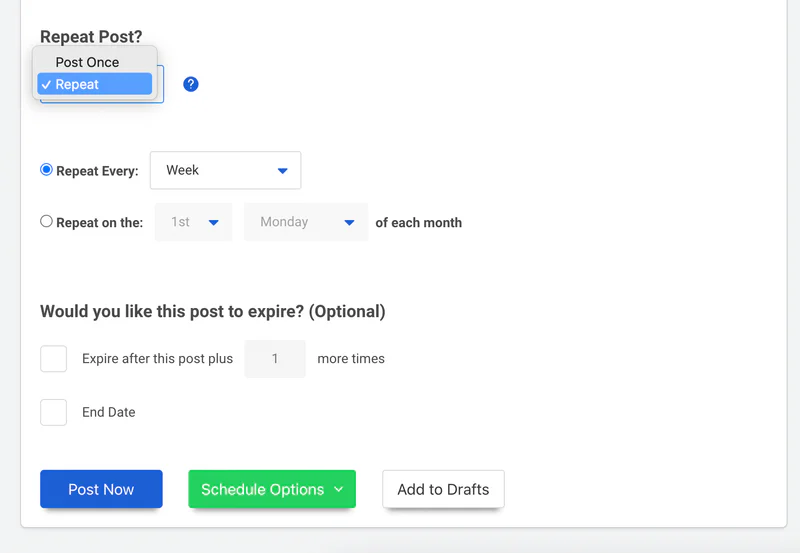
5. Reconnect your AI agents to OneUp's MCP server
PostEverywhere's hosted MCP server is its headline feature, and OneUp has one too — included on every plan, along with its REST API. Point your agent at OneUp's MCP server and test a draft and a scheduled post first.
6. Recreate your approval workflow
Recreate any review step your team used — but note the boundary: approvals start on Intermediate, not Basic, so pick Intermediate or above before inviting approvers. Test with one real post first.
7. Set up crossposting workflows
Create a crossposting workflow — "every new Instagram post also goes to Facebook, X, and Threads" — and OneUp handles the reformatting. Basic includes 1 workflow, Intermediate 3, Growth 5, Business 8.
8. Run both tools, then cancel
Run OneUp live for two weeks while PostEverywhere stays active. Once your queue and agent workflows are publishing cleanly, cancel PostEverywhere.
Plan mapping: PostEverywhere to OneUp
Prices checked November 20, 2026, on posteverywhere.ai. For the wider picture, see How Much Does a Social Media Scheduler Cost? 2026 Pricing Compared.
What you will gain, and what you will miss
You will gain: a ladder that runs past 20 accounts to 80; Snapchat publishing; recurring evergreen posts; crossposting; approvals from Intermediate; a social inbox and listening on every plan; comment auto-replies and DM automations; and AI captions on every plan.
You will miss: PostEverywhere's AI Studio image and video generation, which has no direct equivalent in OneUp beyond AI captions. You will also miss Telegram and WordPress publishing, and the 5-workspace agency layout on Scale. If agent-driven image and video generation is daily work, PostEverywhere is still the right home. Alternatives that keep more of the AI-agent side are in Best PostEverywhere Alternatives in 2026.
Where PostEverywhere wins
PostEverywhere wins outright on price at small scale and on AI-agent depth. At 10 accounts its Growth plan is $29 a month against OneUp Intermediate at $48, and its MCP server exposes around 45 tools with a REST API of 50 endpoints — deeper agent control than OneUp's. Its AI Studio writes captions and generates images and video from the same credit pool, and every plan includes unlimited posts with no caps. For a small AI-first team, PostEverywhere is the cheaper, deeper tool. The switch only makes sense when scale, Snapchat, or team governance enter the picture.
FAQ
Is PostEverywhere really cheaper than OneUp?
At 5 and 10 accounts, yes. Starter is $19 a month for 5 accounts against Basic at $15 billed annually, and Growth is $29 for 10 accounts against Intermediate at $48. PostEverywhere wins on price until you pass 20 accounts, where it has no plan at all.
Can OneUp match PostEverywhere's MCP server?
Yes. OneUp includes a hosted MCP server and REST API on every plan, so agents can draft and schedule posts. PostEverywhere's MCP exposes more tools, so test your agent workflows against OneUp's server before switching.
What happens to my AI credits if I cancel PostEverywhere?
They stay in PostEverywhere. Unused AI credits do not transfer, so use them up — or export generated images and video you want to keep — before cancelling.
Can I keep PostEverywhere for AI generation and OneUp for scheduling?
Yes, but you would be paying for two tools and running two calendars. If AI image and video generation is occasional, generating in PostEverywhere and scheduling in OneUp is workable; if it is daily, keep PostEverywhere as your home.
The bottom line
PostEverywhere is an AI-agent scheduler with a short, cheap ladder; OneUp is a full scheduler that scales further. If 20 accounts, AI Studio generation, and the deepest MCP toolset are your daily work, stay with PostEverywhere. If you are about to outgrow 20 accounts, need Snapchat, or want recurring posts, approvals, and DM automations in the same tool, the switch pays for itself in the first month. Start a 7-day trial.
OneUp
OneUp is a social media management tool. Scheduling, cross-posting, analytics, social inbox, DM automations, social listening, and API & MCP, all in one place.
Visit Site