How to Switch from SocialBee to OneUp Without Losing Your Queue
Switch from SocialBee to OneUp in an afternoon: capture your categories and queue, reconnect accounts, and refill with bulk upload...
Contents
How to Switch from SocialBee to OneUp Without Losing Your Queue
Most people leave SocialBee because the per-profile bill climbs with every account, they need networks SocialBee doesn't cover (Snapchat and Discord), or they want flat pricing without paying extra per user and workspace. The switch is a rebuild, not a transfer: no scheduler can import another tool's queue, because no export format moves scheduled posts between tools. What does move is the thinking behind your queue: categories, timeslots, and the posts themselves, captured as a list.
Quick verdict
You cannot import your SocialBee queue automatically, but rebuilding it takes an afternoon: capture your categories and queued posts as a spreadsheet, reconnect your accounts, refill with bulk upload, and run both tools in parallel until SocialBee's queue drains.
- Time needed: 2 to 4 hours of active work, plus a 1–2 week parallel run.
- The one rule that prevents double-posting: schedule everything new in OneUp only; let queued SocialBee posts publish from SocialBee.
- Cost at 5 accounts: SocialBee Bootstrap is $29 a month on monthly billing ($24.20 a month billed annually) for 5 profiles; OneUp Basic is $15 a month billed annually ($25 month to month) for the same 5 accounts.
- What you gain: 12 networks including Snapchat and Discord, recurring posts and crossposting on every plan, plus API and MCP access. SocialBee has Zapier, Make, and Pabbly integrations, not a public API.
What transfers and what doesn't
Before you start
Capture every queued post with its date and time, note each category's schedule, check your renewal date, and count accounts to pick a plan (Basic 5, Intermediate 15, Growth 30, Business 80).
Step 1: Capture your SocialBee queue and categories (30–45 minutes)
Record every scheduled post (text, link, media, time) in a spreadsheet, one row per post, with its category and posting schedule. That list is the exact spec for rebuilding your queue.
Step 2: Connect your accounts in OneUp (20–30 minutes)
Connect the same accounts in OneUp: it covers Facebook Pages, Groups, personal Profiles, Instagram (including accounts not linked to a Facebook Page), X, LinkedIn, TikTok, YouTube, Pinterest, Threads, Bluesky, Snapchat, Discord, and Google Business Profile. That covers every network SocialBee supports, plus Snapchat and Discord.
Connecting to OneUp leaves SocialBee connected, so the parallel run works. Check each connection; a disconnected account is the most common reason a post silently fails.
Step 3: Recreate your categories and timeslots (15–20 minutes)
In SocialBee you picked a category and a posting schedule; in OneUp, the equivalents are Categories and Timeslots. Map categories one-to-one, then recreate the timeslots. SocialBee cycles through a category's posts at that category's times; OneUp queues posts into timeslots you define. Our SocialBee vs OneUp comparison explains the two models side by side.
Step 4: Refill the queue with bulk upload (30–60 minutes)
Turn your Step 1 spreadsheet into a bulk upload: OneUp loads many posts at once from a CSV, Google Drive, or Dropbox; see our bulk upload walkthrough for the exact format.
Step 5: Recreate evergreen recycling and set up crossposting (20 minutes)
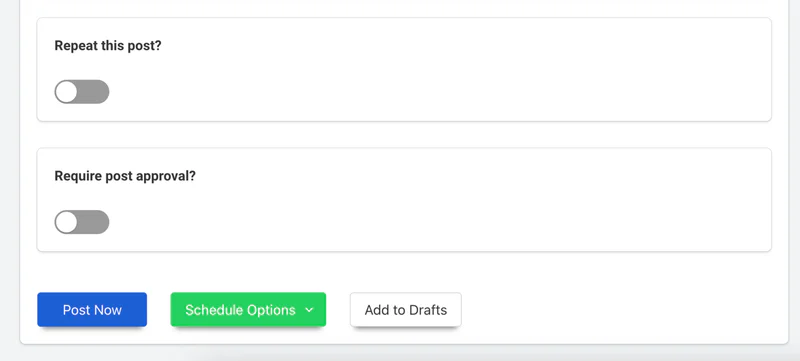
Rebuild evergreen posts as repeating posts in OneUp; both tools include this on every plan. Then set up crossposting: an Instagram Reel can flow to TikTok and YouTube Shorts. Basic includes 1 workflow, Growth 5, Business 8. See our guide to recurring evergreen posts.
Step 6: Rebuild approvals if you use them (10 minutes)
Only for teams using SocialBee approvals, which start on Accelerate at $49 a month. In OneUp, approvals start on Intermediate ($48 a month billed annually), not Basic, so pick Intermediate or higher if approvals matter.
Step 7: Run both tools in parallel until SocialBee's queue drains (1–2 weeks)
From today, everything new goes in OneUp only; everything already queued in SocialBee stays there. Never put the same post in both queues.
Step 8: Cancel SocialBee before your renewal date
Once SocialBee's queue is empty and OneUp has published cleanly, cancel before your renewal date (after downloading final analytics). Typical account: 2 to 4 hours; teams with approvals, a full day. For the broader picture, see our 7 best SocialBee alternatives roundup and pricing comparison.
SocialBee vs OneUp at a glance
Prices checked November 2026.
Where SocialBee wins
SocialBee's category system is genuinely the best in the category. Sorting posts into categories with their own schedules and letting the tool cycle through them beats a flat queue, and its limits are generous: 1,000 posts per category even on Bootstrap, 5,000 on Accelerate. Its RSS sources (10 on Bootstrap, 30 on Accelerate) and Canva integration make feeding those categories easy, and its 14-day trial is twice OneUp's. For a solo creator whose whole system is categories, staying is defensible; switch when the per-profile bill, missing networks, or flat-pricing math outweighs it.
FAQ
Will my scheduled SocialBee posts still publish after I connect the same accounts to OneUp?
Yes. Connecting an account to OneUp leaves SocialBee untouched, so queued posts keep publishing until the queue drains.
Can OneUp import my SocialBee categories automatically?
No. Categories must be recreated by hand, but the mapping is straightforward: one SocialBee category becomes one OneUp category with matching timeslots.
Will I double-post during the switch?
Only if the same post is in both tools. Keep new posts in OneUp and the old queue in SocialBee.
What happens to my SocialBee analytics?
Your history stays in SocialBee while your account exists. Export the reports you care about before you cancel; Bootstrap keeps only 3 months.
Start the switch today
OneUp starts at $15 a month billed annually for 5 accounts, with a 7-day free trial. Start your free trial and follow the eight steps.
OneUp
OneUp is a social media management tool. Scheduling, cross-posting, analytics, social inbox, DM automations, social listening, and API & MCP, all in one place.
Visit Site